Hetzer vs SU-76M
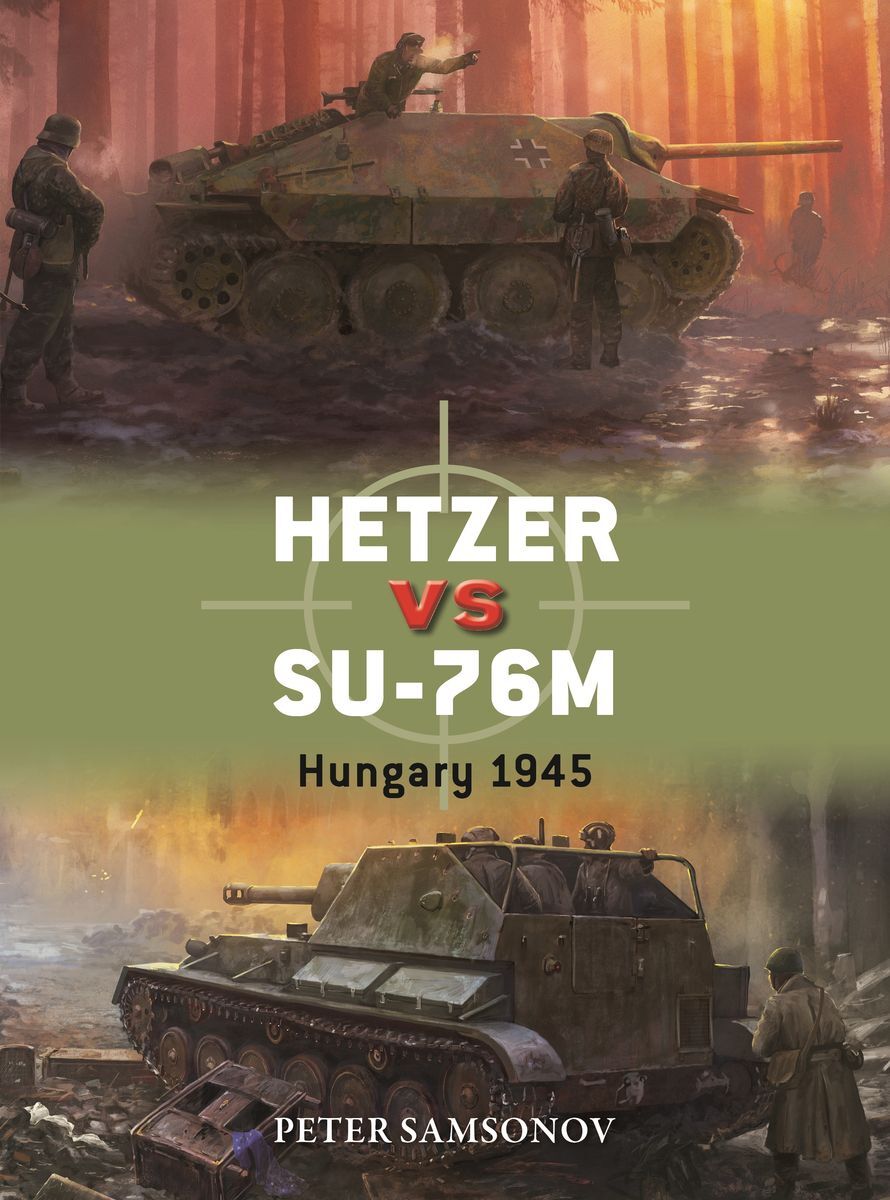
A noted authority examines the roles played by Germany’s Hetzer tank destroyer and the Soviet SU-76M self-propelled gun during the battle for Hungary in 1945.
During World War II, Germany and the Soviet Union soon found that their light tanks were obsolete while their small guns were no longer useful against the enemy’s armoured vehicles, the chassis allowed for installation of a larger gun at the cost of a rotating turret. Keen to utilize existing technology, Germany and the Soviet Union approached this challenge differently. While the Germans turned their PzKpfw 38(t) tank into a tank destroyer, first the open-topped Marder III and then the fully enclosed Jagdpanzer 38(t), nicknamed the ‘Hetzer’, the Soviet designers turned the T-70 light tank into an infantry support gun capable of engaging enemy armour, its open-topped fighting compartment adding communication with accompanying infantry.
In this study, leading armour expert Peter Samsonov’s insightful analysis is complemented by specially commissioned artwork and mapping alongside carefully selected archive and present-day photographs, revealing the origins, development and combat performance of these two types at war. Both were widely employed amid the tank battles of early 1945, as Soviet forces reached deep into Hungary and the Axis armies mounted one last counter-offensive on the Eastern Front, Operation Spring Awakening.
| Cena det. | 87,00 zł |
|---|---|
| Data wydania | 2025-12-18 |
| Rok wydania | 2025 |
| Autor | Peter Samsonov |
| Wydawca | Osprey Publishing |
| Format | 248 x 185 x 5 mm |
| Liczba stron | 80 |
| Oprawa | Miękka |
| ISBN | 9781472866103 |
| EAN | 9781472866103 |
| Numer katalogowy | 801348 |
- Podana przy każdym produkcie „Dostępność” oznacza czas potrzebny do skompletowania zamówienia zawierającego dany produkt i wysłania go z magazynu. W tym przypadku dostępność nie oznacza więc przewidzianego dla danego sposobu wysyłki czasu dostawy, np. czasu potrzebnego kurierowi na dostarczenie paczki pod wskazany adres lub do punktu odbioru.
- Przykładowo „Dostępność: 1 dzień roboczy” oznacza, że dany produkt jest dostępny w naszym magazynie i zostanie wysłany do klienta w kolejnym dniu roboczym od daty złożenia zamówienia.
- Warto pamiętać, że zamówienie zawierające produkty z różnym czasem dostępności zostanie wysłane z magazynu w terminie najdalszym z podanych. Jeżeli zależy Państwu na szybkiej realizacji zamówienia, rekomendujemy wybór produktów z najkrótszym czasem dostępności.