Johannes Balle’s Tunumiisut (East Greenlandic) wordlist
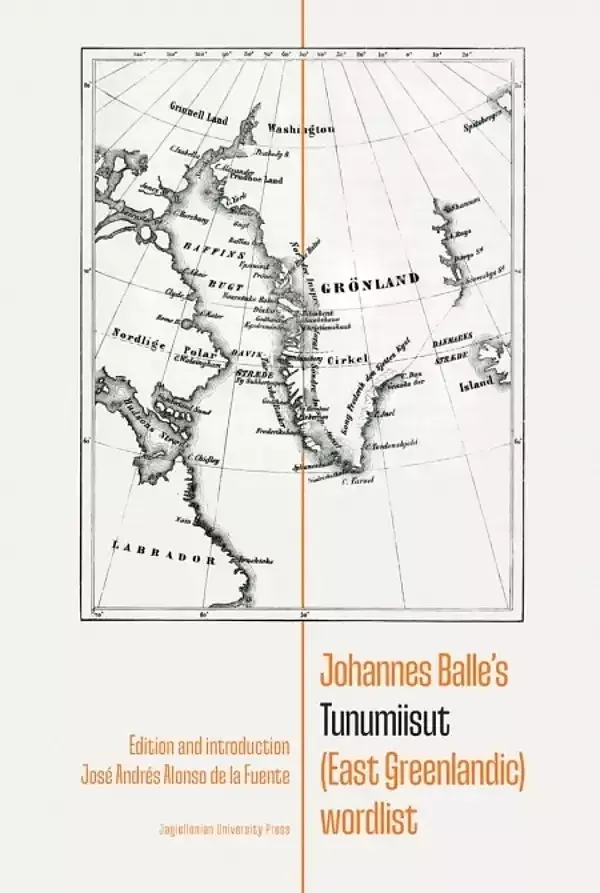
The work examines the Tunumiisut (East Greenlandic) wordlist gathered by Johannes Balle (1889–1965) sometime in the first half of the 20th century. This little-known vocabulary, which includes equivalents in Kalaallisut (West Greenlandic) and translations into Danish, offers valuable data from a time when information on Greenlandic dialects was scarce and difficult to obtain.
The present publication is a pioneering study. There is no previous scholarship on the wordlist, which exists in two copies held at the Royal Danish Library and the Danish Arctic Institute (Arktisk Institute). The author describes the historical context of Johannes Balle’s life and the peculiarities of the linguistic data as presented in the wordlist. The main part of the study is the Tunumiisut wordlist re-arranged according to English keywords for historical and comparative purposes. Extensive indices arranged in the more traditional alphabetical order allow the reader to navigate easily through Tunumiisut, Kalaallisut, Proto-Inuit-Yupik and Proto-Inuit reconstructions, all of them cross-referenced with the English keywords.
José Andrés Alonso de la Fuente (born 1982) is Associate Professor at the Institute of Linguistics, Translation Studies and Hungarian Studies of the Jagiellonian University in Kraków. His main interests lie in historical linguistics, language contact and typology. He holds a PhD degree in Linguistics (2012) from the University of the Basque Country (Spain).
| Cena det. | 51,45 zł |
|---|---|
| Data wydania | 2025-03-20 |
| Rok wydania | 2025 |
| Autor | José Andrés Alonso de la Fuente |
| Wydawca | Wydawnictwo Uniwersytetu Jagiellońskiego |
| Format | 163 x 235 mm |
| Liczba stron | 220 |
| Oprawa | Miękka |
| ISBN | 9788323354833 |
| EAN | 9788323354833 |
| Numer katalogowy | 641561 |
- Podana przy każdym produkcie „Dostępność” oznacza czas potrzebny do skompletowania zamówienia zawierającego dany produkt i wysłania go z magazynu. W tym przypadku dostępność nie oznacza więc przewidzianego dla danego sposobu wysyłki czasu dostawy, np. czasu potrzebnego kurierowi na dostarczenie paczki pod wskazany adres lub do punktu odbioru.
- Przykładowo „Dostępność: 1 dzień roboczy” oznacza, że dany produkt jest dostępny w naszym magazynie i zostanie wysłany do klienta w kolejnym dniu roboczym od daty złożenia zamówienia.
- Warto pamiętać, że zamówienie zawierające produkty z różnym czasem dostępności zostanie wysłane z magazynu w terminie najdalszym z podanych. Jeżeli zależy Państwu na szybkiej realizacji zamówienia, rekomendujemy wybór produktów z najkrótszym czasem dostępności.
Inne z tej kategorii