Digital Signal and Image Processing in Jagiellonian Positron Emission Tomography
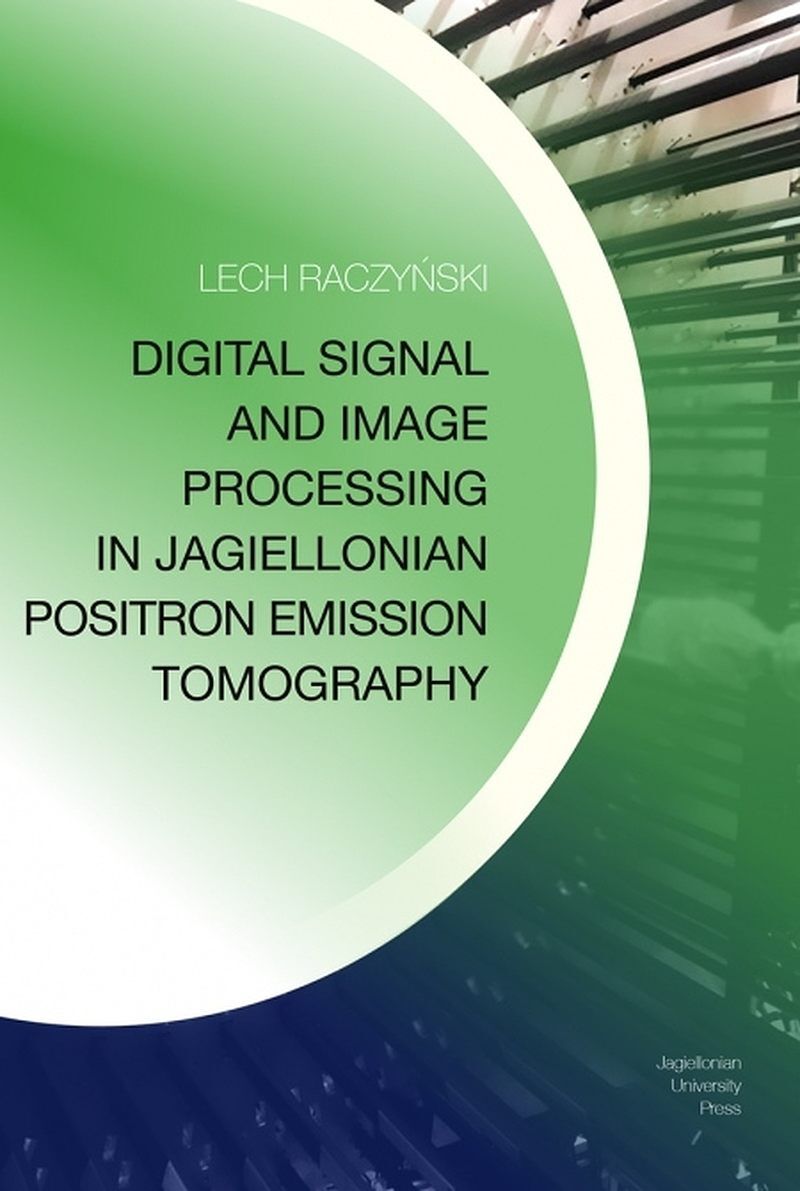
Dissertation of Lech Raczyński is devoted to the presentation of data processing algorithms in the Jagiellonian PET (J-PET) scanner. The work describes original and inventive methods of signal and image reconstruction. I consider their development a great achievement due to the complex methodology of determining the position in the J-PET scanner based on measurement of the light pulses propagation time in long plastic scintillators. The author applies modern methods of data processing, like compressive sensing theory and total variation regularization technique. For their evaluation both experimental and simulation data of the J-PET scanner were used. This work is an important contribution to the field of PET. The presented results are crucial to the success of the J-PET project.
prof. dr hab. Jerzy Smyrski, Faculty of Physics, Astronomy, and Applied Computer Science Jagiellonian University
Lech Raczyński graduated from the Faculty of Electronics and Information Technology of the Warsaw University of Technology. His scientific interests lie in the area of compressed acquisition methods, data processing and analysis, artificial intelligence and probabilistic mathematics, and the application of these disciplines, in particular in medicine. Since 2012, he belongs to the group at the National Centre for Nuclear Research, which cooperates with the Jagiellonian University in the construction of a modern Positron Emission Tomography device. His efforts focus on the development of new concepts and techniques for signal and image processing.
| Cena det. | 41,90 zł |
|---|---|
| Data wydania | 2021-10-20 |
| Rok wydania | 2021 |
| Autor | Lech Raczyński |
| Wydawca | Wydawnictwo Uniwersytetu Jagiellońskiego |
| Format | 170 x 240 mm |
| Liczba stron | 124 |
| Oprawa | Miękka |
| ISBN | 9788323350156 |
| EAN | 9788323350156 |
| Numer katalogowy | 502129 |
- Podana przy każdym produkcie „Dostępność” oznacza czas potrzebny do skompletowania zamówienia zawierającego dany produkt i wysłania go z magazynu. W tym przypadku dostępność nie oznacza więc przewidzianego dla danego sposobu wysyłki czasu dostawy, np. czasu potrzebnego kurierowi na dostarczenie paczki pod wskazany adres lub do punktu odbioru.
- Przykładowo „Dostępność: 1 dzień roboczy” oznacza, że dany produkt jest dostępny w naszym magazynie i zostanie wysłany do klienta w kolejnym dniu roboczym od daty złożenia zamówienia.
- Warto pamiętać, że zamówienie zawierające produkty z różnym czasem dostępności zostanie wysłane z magazynu w terminie najdalszym z podanych. Jeżeli zależy Państwu na szybkiej realizacji zamówienia, rekomendujemy wybór produktów z najkrótszym czasem dostępności.
Inne z tej kategorii